- 1. Look for Painful Spreadsheet Workarounds First
- 2. Three Validation Experiments Before Full Engineering
- 3. Keep Version One Intentionally Focused
- Practical Comparison & Decision Matrix
- 4. Illustrative Arithmetic: Evaluating Micro-SaaS Unit Economics
- Frequently Asked Questions (FAQ)
- Official Reference Material
- Continue Reading Related Guides
- Operational Execution & Risk Management
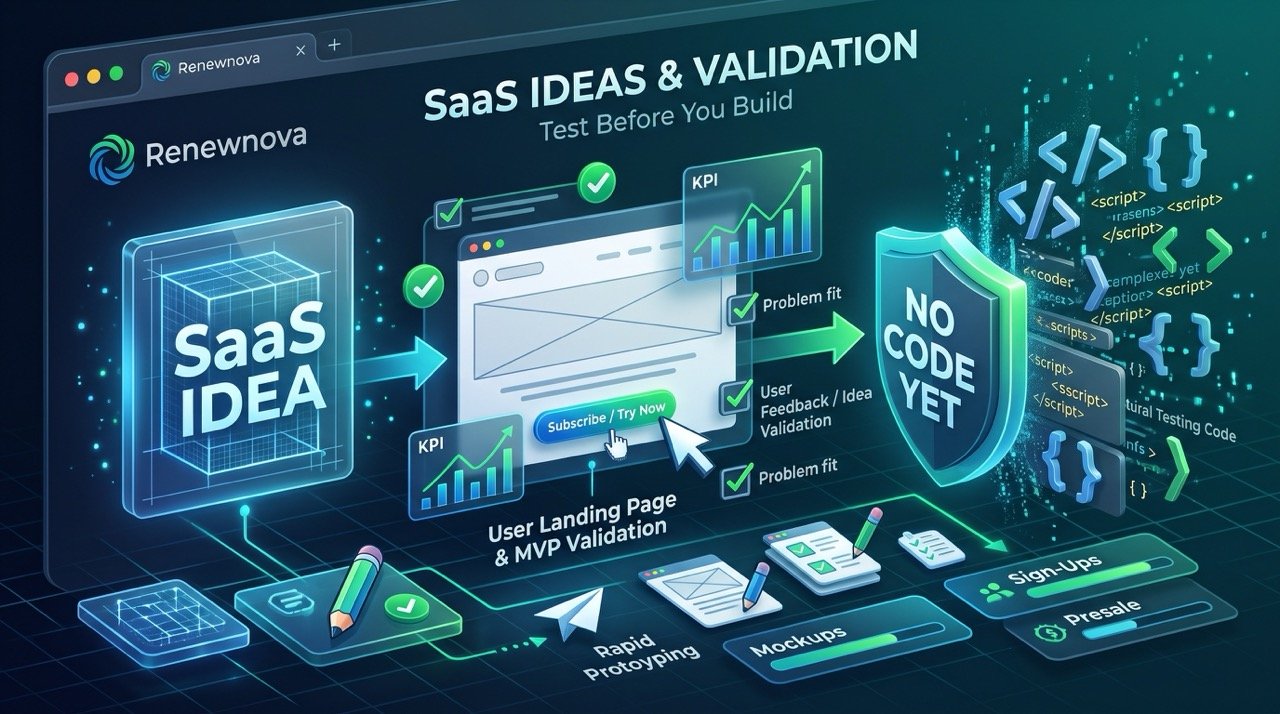
Most independent software projects fail not because of engineering bugs, but because they automate a problem nobody is actively trying to solve. Validating demand through manual workflows, user interviews, and lightweight prototypes saves months of wasted development effort.
1. Look for Painful Spreadsheet Workarounds First
The strongest micro-SaaS and web utility products replace fragile spreadsheets, repetitive data-entry routines, or error-prone manual calculations. When potential users already maintain custom formulas or pay assistants to compile weekly reports, budget and urgency already exist.
Conversely, if prospective buyers cannot describe how they currently manage the task without your software, the problem is rarely urgent enough to justify recurring subscription fees.
- Frequency Signal: Prioritize tasks performed daily or weekly rather than once-a-year edge cases.
- Financial Consequence: Focus on workflows where human error causes missed invoices, compliance penalties, or lost leads.
- Clear Buyer Identity: Target a specific role (such as independent consultants, e-commerce store managers, or content editors) rather than “all businesses.”
2. Three Validation Experiments Before Full Engineering
Before configuring databases, authentication layers, or subscription billing, test whether real practitioners value the outcome enough to commit time or money.
- Step 1 — Problem Discovery Interviews: Conduct 8 to 10 structured conversations focusing on past behavior (“Walk me through the last time you completed this task”) instead of hypothetical future promises (“Would you use an app that does X?”).
- Step 2 — Concierge Manual Pilot: Deliver the finished report, calculation, or formatted output manually for three early users. This exposes real edge cases and required export formats immediately.
- Step 3 — Paid Pilot or Pre-Order Test: Present a clickable prototype and offer a discounted founding-member pilot to verify real willingness to pay.
3. Keep Version One Intentionally Focused
A profitable niche tool solves one high-friction bottleneck reliably. Defer team permissions, complex integrations, and custom themes until paying users consistently complete the core workflow every week.
Practical Comparison & Decision Matrix
| Validation Stage | Primary Deliverable | Success Signal | Time Budget |
|---|---|---|---|
| Problem Interviews | 8–10 practitioner notes | Users describe active manual workarounds | 3–4 days |
| Clickable Mockup | 3–4 core screens | Users understand value without explanation | 2 days |
| Concierge Pilot | Manual output for 3 users | Users rely on the output in real work | 5 days |
| MVP Launch | Single-workflow web tool | Weekly retention & paid conversions | 2–3 weeks |
4. Illustrative Arithmetic: Evaluating Micro-SaaS Unit Economics
Suppose you build a specialized invoicing compliance checker priced at $19 per month. Acquiring 150 active subscribers generates $2,850 in gross monthly recurring revenue. After deducting $180 for cloud hosting and transactional email, $140 for payment processing fees, and $250 for software tools, net pre-tax operating margin reaches $2,280 per month.
Modeling these numbers before writing code clarifies how many customers you actually need to reach sustainability—and shows why low-churn niche tools outperform broad, high-support consumer apps.
Frequently Asked Questions (FAQ)
How many user interviews are enough before starting development?
Eight to ten interviews within a single narrow niche usually reveal recurring patterns. If every interviewee describes a completely different workflow, narrow your target audience further.
Should I offer a free forever plan at launch?
For niche B2B tools, a time-limited free trial or interactive calculator preview usually converts better than an unlimited free tier that attracts non-buyers and increases support load.
What tech stack is best for a first micro-SaaS?
Use the stack you already know best. Customers care about speed, reliability, and accurate outputs—not which framework powers your backend.
When should I abandon a validated idea?
If prospects praise the concept during interviews but refuse a low-cost pilot or cannot provide real sample data to test, pivot to a more urgent operational problem.
Official Reference Material
- U.S. SBA: Market Research and Competitive Analysis
- FTC: Advertising and Pricing Transparency Guidance
Continue Reading Related Guides
Operational Execution & Risk Management
Putting Validating a Micro-SaaS or Web Tool Idea Before Writing Code into practice requires balancing speed with financial discipline. Validate customer demand through small, reversible tests and track net profit after platform fees, subscriptions, and taxes.
7-Day Execution Roadmap
- Days 1–2 (Constraint Check): Define your weekly time budget, cash buffer, and primary success metric for the next 30 days.
- Days 3–4 (Minimum Viable Test): Launch a focused pilot with real users or buyers to gather direct behavioral feedback.
- Days 5–7 (Iteration): Keep what produces measurable traction, cut low-leverage tasks, and document your checklist.
Apply one useful step, measure the result, and continue with the most relevant guide.