- 1. Why Real-Time Chat Slows Down Remote Productivity
- 2. Four Operational Pillars of an Async Workflow
- 3. When Synchronous Calls Still Make Sense
- Practical Comparison & Decision Matrix
- 4. Illustrative Impact: Reclaiming 7 Hours of Focus Time Weekly
- Frequently Asked Questions (FAQ)
- Official Reference Material
- Continue Reading Related Guides
- Operational Execution & Risk Management
Distributed work fails when teams simply copy noisy office habits onto chat apps. Replacing constant status meetings with structured written updates, shared decision logs, and clear response windows protects deep focus while keeping collaborators aligned across time zones.
1. Why Real-Time Chat Slows Down Remote Productivity
Treating instant messaging like an urgent phone call fragments attention and forces specialists in different time zones to stay online outside healthy hours. When critical decisions are buried inside fast-moving chat channels, team members waste hours searching for context or repeating work.
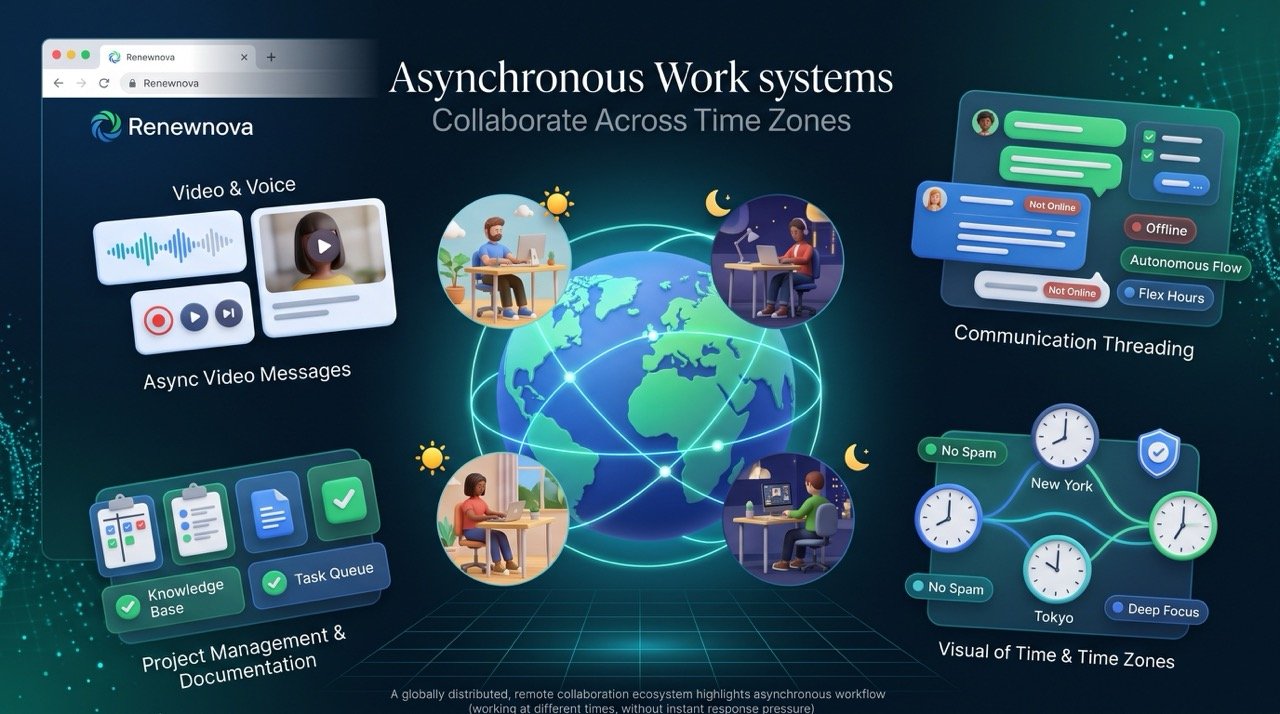
High-performing remote organizations default to asynchronous communication—writing complete, self-contained updates that colleagues can read and act upon during their own focused work blocks.
- Protected Deep Work: Specialists gain uninterrupted 3-to-4-hour blocks for complex analysis, writing, or coding.
- Time-Zone Independence: Projects move forward smoothly between Europe, North America, and Asia without midnight calls.
- Searchable Institutional Memory: Written decisions remain accessible to new hires months later.
2. Four Operational Pillars of an Async Workflow
Transitioning from reactive messaging to structured async collaboration requires four simple agreements across your team or client relationships.
- Pillar 1 — Context-Complete Messages: Never send a bare “Hi” or “Do you have a minute?” Include the objective, background links, current blocker, and proposed solution in one structured note.
- Pillar 2 — Single Source of Truth: Move final specifications and approvals out of chat and into a shared project document with clear version dates.
- Pillar 3 — Explicit Response Windows: Define expected turnaround times (such as 24 business hours for standard reviews) alongside a separate escalation path for genuine production emergencies.
- Pillar 4 — Short Screen Walkthroughs: Record a two-minute video walkthrough when demonstrating visual feedback or complex handoffs.
3. When Synchronous Calls Still Make Sense
Asynchronous work does not mean zero human interaction. Reserve live video calls for sensitive performance feedback, complex architectural brainstorming, and relationship building—always supported by a written agenda beforehand and action items afterward.
Practical Comparison & Decision Matrix
| Communication Type | Best Tool / Format | Expected Response Window | Primary Use Case |
|---|---|---|---|
| Daily Status & Progress | Written project log / checklist | Within 24 business hours | Routine updates without meetings |
| Design or Code Handoff | 2-minute screen recording + notes | Same or next business day | Visual clarity across time zones |
| Complex Brainstorming | Scheduled 30-min call + agenda | Real-time synchronous | Resolving ambiguity quickly |
| Critical System Outage | Direct phone / priority alert | Under 30 minutes | True operational emergencies |
4. Illustrative Impact: Reclaiming 7 Hours of Focus Time Weekly
Consider a five-person remote digital agency holding a daily 30-minute status call plus three ad-hoc weekly syncs. Those meetings consume 4 hours per person directly—and roughly 3 additional hours in context-switching recovery.
By replacing the daily status call with a structured 5-bullet written check-in every morning, the team recovers over 7 hours of uninterrupted production capacity per specialist each week while maintaining clearer accountability.
Frequently Asked Questions (FAQ)
How do remote freelancers apply async rules with traditional clients?
Set expectations during onboarding: share a weekly written progress summary every Friday and offer one scheduled check-in call per milestone so clients feel informed without daily interruptions.
What makes a written update effective instead of overwhelming?
Lead with the conclusion or decision needed in the first two sentences, use bullet points for supporting facts, and bold any action items with owner names and deadlines.
Which metrics show that async communication is working?
Track weekly meeting hours per person, average turnaround time on pull requests or content reviews, and self-reported uninterrupted focus blocks.
How do we prevent isolation in an async remote setup?
Schedule optional social coffee chats or monthly team retrospectives dedicated to connection rather than status reporting.
Official Reference Material
- International Labour Organization (ILO): Digital Labour & Remote Work Resources
- U.S. SBA: Managing Operations and Distributed Teams
Continue Reading Related Guides
Operational Execution & Risk Management
Putting Asynchronous Communication Systems for Distributed Remote Teams into practice requires balancing speed with financial discipline. Validate customer demand through small, reversible tests and track net profit after platform fees, subscriptions, and taxes.
7-Day Execution Roadmap
- Days 1–2 (Constraint Check): Define your weekly time budget, cash buffer, and primary success metric for the next 30 days.
- Days 3–4 (Minimum Viable Test): Launch a focused pilot with real users or buyers to gather direct behavioral feedback.
- Days 5–7 (Iteration): Keep what produces measurable traction, cut low-leverage tasks, and document your checklist.
Apply one useful step, measure the result, and continue with the most relevant guide.